

One System. Fewer Problems to Manage During a Hospital Expansion.
Expanding an active hospital means managing two completely different environments at the same time.
On one side: patients, staff, conditioned spaces, and hospital operations that can't simply stop.
On the other: an active construction site with crews, equipment, exposed building areas, weather, changing work zones, and multiple trades trying to stay on schedule.
And somewhere between the two?
Your construction team has to create separation, protect exposed areas, control the environment, manage perimeter safety, and keep construction moving.
That's a lot of temporary problems to coordinate.
What if one system could help solve several of them at once?
That's where RWES changes the approach to hospital construction and healthcare construction.
Hospital Expansion Creates More Than One Temporary Problem
Before permanent walls, glazing, windows, doors, and other portions of the building envelope are complete, contractors still have work that needs to happen.
You may need to:
Separate active construction from occupied hospital areas
Protect unfinished work from rain, snow, and wind
Add temporary insulation to help maintain more controlled temperatures
Provide construction fall protection systems at exposed edges
Control dust and debris
Maintain crew and material access
Enclose scaffolding or building penetrations
Move protection as construction progresses
Traditionally, those can become separate problems requiring separate temporary solutions.
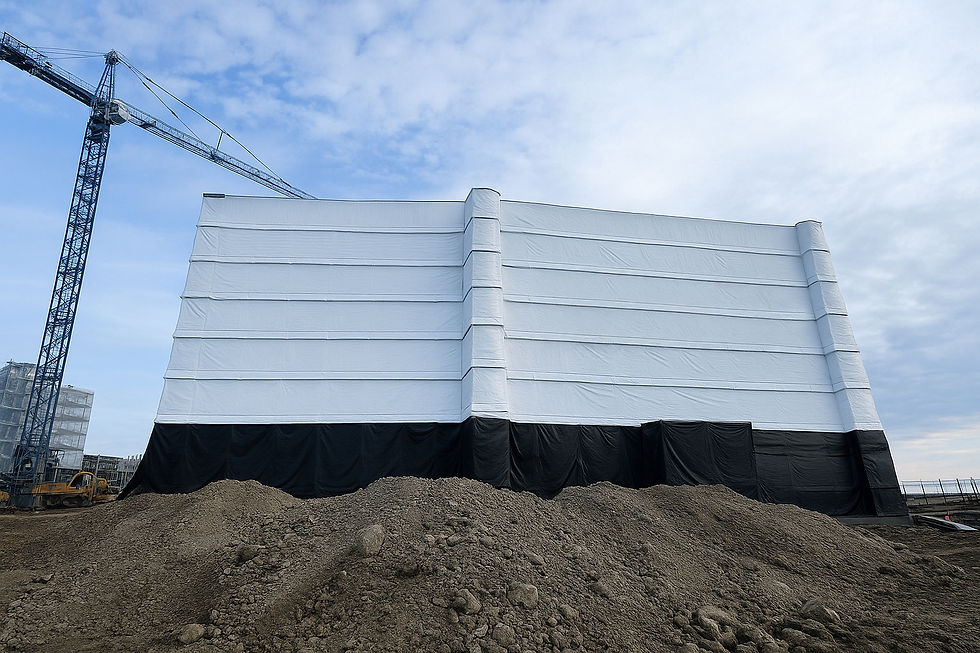
RWES gives contractors a way to address several of them through one flexible construction enclosure system.
How Do You Separate Construction From an Active Hospital?
This can be one of the biggest concerns during an occupied hospital expansion.
The existing facility still has a job to do.
Patients need care.
Staff need to work.
Hospital operations need to continue.
Meanwhile, major construction may be happening feet away.
RWES creates a durable construction barrier that can help establish physical separation between active construction and surrounding environments.
For interior applications, RWES can be configured for:
Occupied-building separation
Temporary walls and partitions
Dust and debris containment
Corridor and walkway protection
Restricted construction zones
Equipment and asset protection
Phased construction areas
Integrated doors and viewing windows can also be added where controlled access, material movement, visibility, or site supervision is needed.
Construction stays on the construction side. Hospital operations stay on the hospital side.
How Do You Maintain Temperature During a Hospital Expansion?
Physical separation is only part of the challenge.
An active hospital may have conditioned spaces directly beside an unfinished expansion.
If the permanent building enclosure system isn't complete, maintaining consistent interior conditions can become more difficult.
RWES can be upgraded with temporary insulation when additional thermal performance is needed.
Insulated RWES configurations can provide approximately R-12 thermal performance, helping reduce heat transfer through exposed construction areas.
In colder conditions, insulation helps retain heat.
In warmer conditions, it helps reduce exterior heat entering the protected area.
Insulation can also help reduce condensation and create more comfortable working conditions for crews.
That makes temporary wall insulation particularly useful when construction needs to continue through extreme temperatures or directly beside conditioned occupied spaces.
The building may be under construction. The people inside still need to be comfortable.
How Do You Protect an Unfinished Hospital From Rain, Wind, and Weather?
Rain doesn't care that interior work starts Monday.
Wind doesn't care about next week's inspection.
And a sudden temperature change doesn't care about the construction schedule.
That's why temporary weather protection for construction should be planned before weather becomes a problem.
RWES creates a highly weather-tight construction site enclosure designed to help protect unfinished construction from rain, wind, snow, and changing exterior conditions.
For projects where a tighter enclosure is needed, RWES also offers vertical seam flaps designed to reduce gaps between panels and improve protection against wind, rain, dust, and debris.
RWES is also designed for demanding weather conditions and has withstood winds of more than 100 mph.
The benefit isn't simply keeping weather outside.
It's protecting what needs to keep happening inside.
Interior work can progress.
Crews can remain productive.
Materials can stay better protected.
Trades can keep moving.
Milestones become less dependent on tomorrow's forecast.
You can't control the weather. You can control how exposed your project is to it.
Construction Weather Protection Is Really Schedule Protection
A weather delay doesn't always end when the weather clears.
Water intrusion can affect unfinished areas.
Materials can become exposed.
Interior work can be pushed.
Crews can lose productive hours.
The next trade may not be able to start.
An inspection or milestone can move.
One environmental problem can create a chain reaction through the schedule.
That's why construction weather protection is really about protecting more than the building.
It's schedule protection.
For a complex healthcare construction project with multiple trades, inspections, equipment installations, and critical milestones, controlling environmental exposure can help reduce one major source of uncertainty.
How Fast Can a Temporary Construction Enclosure Be Installed?
When exposed construction is holding up work, installation speed matters.
RWES installs 50–80% faster than traditional tarp systems, helping contractors establish temporary weather protection without unnecessarily slowing other work on the project.
That means exposed areas can be protected sooner and crews can focus on moving the project forward.
Get protected faster. Keep the hospital expansion moving.
Can Weather Protection and Fall Protection Work Together?
Weather isn't the only concern around the perimeter of a multi-story hospital expansion.
There's also jobsite safety.
RWES Guardwalls combine enclosure with guardrail capabilities, allowing contractors to coordinate the weather enclosure with leading-edge protection.
Depending on the project configuration, the system can integrate with components such as safety rails, parapet clamps, and edge protection.
RWES Guardwalls are designed to exceed applicable OSHA 1910.29 guardrail requirements.
That doesn't replace the project's overall construction safety program, required safety professionals, site-specific planning, or applicable OSHA responsibilities.
It does allow contractors to consider weather protection and certain perimeter-protection requirements together instead of automatically treating them as two completely separate temporary systems.
One perimeter. Multiple requirements. A more coordinated approach.
Who Installs RWES?
Every contractor has different workforce, schedule, and project requirements.
That's why RWES offers three options.
Supply Only
RWES provides the complete system delivered to your site, ready for your crew to install.
Your team maintains control of the installation while being backed by detailed shop drawings and virtual support from RWES experts.
Supply With Lead Hand
RWES supplies the full system and sends an experienced RWES lead hand to guide your crew on site.
Your team performs the installation with hands-on direction, shop drawings, and virtual support throughout the process.
Supply & Install
For a fully turnkey solution, RWES handles delivery, installation, and teardown.
This can help minimize strain on your workforce while giving you an experienced team familiar with the system.
Choose the level of support that works for your project and your crew.
Can a Temporary Construction Enclosure Move as the Building Goes Up?
Yes.
And on a phased hospital expansion, that's a major advantage.
The area you're protecting today may not be the area that needs protection three months from now.
Floors progress.
Openings close.
Permanent glazing goes in.
Interior work advances.
New areas become exposed.
Trades move.
RWES is reusable and reconfigurable, allowing panels to be removed, relocated, and reconfigured as project needs change.
Instead of treating a temporary construction enclosure as something that solves one opening and then loses its usefulness, the system can move with the project.
Use it. Move it. Reconfigure it. Put it back to work.
RWES is also Cradle to Cradle Certified, giving contractors a reusable approach to temporary construction protection.
That can mean less wasted material, less repeated work, and more value from the same enclosure system throughout a multi-phase project.
Can a Temporary Construction Enclosure Open for Large Equipment?
Yes. RWES can be configured around equipment and material access requirements.
At the Medpace 300 healthcare construction project, crews needed weather protection at an expansion joint while also needing to move large mechanical equipment, including AHUs, through the same opening.
RWES was configured as a retractable temporary construction enclosure.
When equipment needed to move through, the enclosure could open.
When weather protection was needed, it could close.
That allowed the project to maintain access without giving up its weather-protection strategy.
The enclosure adapted to the way the jobsite needed to work.
Can Temporary Construction Enclosures Work With Scaffolding?
Yes.
RWES can be configured to work directly with scaffold systems for containment, weather protection, and protected access during:
Façade work
Building penetrations
Exterior renovations
Multi-story construction
Active-facility construction
This can be particularly useful during hospital expansions where crews may be performing exterior work directly beside an occupied healthcare facility.
Can RWES Be Customized for a Hospital Construction Project?
Yes.
Every jobsite is different, so RWES isn't limited to one standard configuration.
Available add-ons and upgrades include:
Insulation for additional thermal performance
Vertical seam flaps for improved weather resistance
Doors and viewing windows for access and visibility
Fire-retardant coating for projects with additional fire-safety requirements
Custom decals for branding, safety messaging, directional signage, or zone identification
Scaffold integration for façade work, building penetrations, and other scaffold applications
RWES can support both exterior and interior construction applications, allowing the enclosure to be configured around the project's weather, access, containment, comfort, safety, and operational requirements.
Build the enclosure your project actually needs—not a one-size-fits-all solution.
One System. Fewer Temporary Problems.
This is where the bigger value starts to become clear.
RWES isn't replacing the skilled people responsible for building a healthcare facility.
It's helping reduce the temporary work competing for their attention.
Instead of independently solving weather protection, temporary separation, thermal performance, perimeter enclosure, leading-edge protection, installation, and changing work zones, contractors can approach several of those needs through one coordinated system.
That can mean fewer temporary systems to manage, less repeated work, and more time focused on actual construction.
Your best people should be building the project—not constantly rebuilding temporary protection around it.
Frequently Asked Questions
How do you protect a hospital construction project from weather before the building is fully enclosed?
A temporary construction enclosure can protect exposed floors, openings, and work areas while permanent walls, glazing, windows, and doors are still being completed.
RWES creates a strong, reusable barrier against rain, snow, wind, and changing exterior conditions. Because the system is reusable and reconfigurable, it can also move as construction progresses.
RWES installs 50–80% faster than traditional tarp systems, helping contractors get exposed areas protected quickly and keep construction moving.
How do you keep rain and wind out of a building during construction?
A construction weather protection system can enclose exposed portions of a building before the permanent building envelope is complete.
RWES creates a tensioned weather enclosure designed for demanding construction environments and has withstood winds of more than 100 mph.
For healthcare construction, that can help protect unfinished work, materials, equipment, and working areas while reducing exposure to changing exterior conditions.
How can construction continue before the windows and exterior walls are installed?
Contractors can use a temporary building enclosure system to create protected work areas while permanent exterior components are still being installed.
RWES can enclose exposed floors, building perimeters, scaffolding, penetrations, and other openings so scheduled work can continue in more controlled conditions.
This can be particularly valuable when interior construction needs to progress before permanent glazing or exterior walls are complete.
Can you keep a construction site heated or cooled before the building is fully enclosed?
A temporary enclosure can help contain conditioned air and reduce exposure to exterior temperatures.
RWES can also be upgraded with insulation when additional thermal performance is needed. Insulated configurations can provide approximately R-12 thermal performance, helping reduce heat transfer, reduce condensation, and create more comfortable working conditions during extreme heat or cold.
What's the best temporary wall for separating hospital construction from occupied areas?
The right temporary wall for construction depends on the project's containment, access, safety, and environmental requirements.
RWES can be configured for occupied-building separation, temporary walls and partitions, dust and debris containment, corridor protection, restricted work zones, and phased construction areas.
Integrated doors and viewing windows can also be added when crews need controlled access or visibility without removing enclosure panels.
How do you control dust and debris during an active hospital renovation?
A construction site containment system can create physical separation between active work and surrounding occupied areas.
RWES can be configured for interior applications including dust and debris containment, occupied-building separation, temporary partitions, corridor protection, overhead drop protection, and restricted construction zones.
The enclosure can also incorporate doors and viewing windows where controlled access or visibility is required.
Can weather protection and fall protection be part of the same construction system?
RWES Guardwalls can combine enclosure with fall protection and leading-edge protection, allowing contractors to consider perimeter protection and weather enclosure together.
RWES Guardwalls are designed to exceed applicable OSHA 1910.29 guardrail requirements. The project's overall safety program, site-specific hazards, and applicable regulations still determine the required construction fall protection systems and safety procedures.
Are temporary construction enclosures reusable?
RWES is designed to be reusable and reconfigurable and is Cradle to Cradle Certified.
Panels can be removed, relocated, and reconfigured as construction progresses rather than being limited to one opening or one phase.
That can allow the same system to continue providing value as work moves throughout a hospital construction project.
Do I have to use my own crew to install RWES?
No.
RWES offers Supply Only, Supply With Lead Hand, and Supply & Install options.
Contractors can choose to have their own crew install the system with shop drawings and virtual support, have an experienced RWES lead hand guide their crew on site, or choose a fully turnkey option where RWES handles delivery, installation, and teardown.
How do I know which temporary construction enclosure is right for my hospital project?
Start with the problems the project needs to solve.
Do you need to keep weather out?
Maintain more controlled temperatures?
Separate construction from occupied hospital areas?
Control dust and debris?
Protect an exposed building edge?
Keep an opening accessible for equipment?
Work around scaffolding?
Move the enclosure as construction progresses?
RWES can be configured around those project requirements rather than forcing every jobsite into the same setup.
Keep the Hospital Running. Keep the Expansion Moving.
An active hospital expansion has two environments that both need to keep functioning.
The hospital still has patients.
Staff still need to work.
Conditioned spaces still need to remain comfortable.
Construction still needs to progress.
Safety requirements don't disappear.
And the schedule certainly doesn't stop.
RWES helps create the separation and protection needed between those environments while giving construction teams a reusable system designed around how projects actually progress.
Separate active construction.
Protect exposed work.
Help control the environment.
Support perimeter safety.
Move and reuse the system as construction progresses.
One system. Fewer temporary problems. More time focused on building.
Keep Reading: More Hospital Construction Insights
How Top Hospital Construction Teams Protect Active Facilities During Expansion
See how temporary enclosures can help create separation between active construction and occupied healthcare spaces as an expansion progresses.
How to Keep an Active Hospital Protected During Construction
See how planning containment and weather protection before opening the existing building can help protect active hospital operations.
The Temporary Construction Strategy That Makes a Complicated Hospital Jobsite Easier
See how RWES can adapt when a hospital project needs weather protection and equipment access through the same opening.


Comments