

How a Building Enclosure System Enables Safe, On-Schedule Construction in Active Airports
Airports don’t get the luxury of shutting down for construction. With millions of passengers moving through terminals every year, even minor disruptions can ripple into delays, safety concerns, and lost revenue. That’s why major airports are increasingly relying on a building enclosure system to keep construction on schedule while staying fully operational.
From weather protection to safety control and phased construction flexibility, this approach has become essential for complex airport projects—especially those happening inside active terminals.
Two large-scale airport expansions show exactly why.

Temporary Construction Enclosures at $2B Active Airport Expansion at PDX Airport
The $2 billion expansion at Portland International Airport (PDX) required construction crews to work inside one of the Pacific Northwest’s busiest airports—without interrupting daily operations. Serving 35 million passengers annually, PDX had no room for error.
Using temporary construction enclosures, crews were able to maintain a clear separation between construction zones and public terminal spaces. This allowed work to move forward safely and on time while passengers continued to travel through the airport as usual.
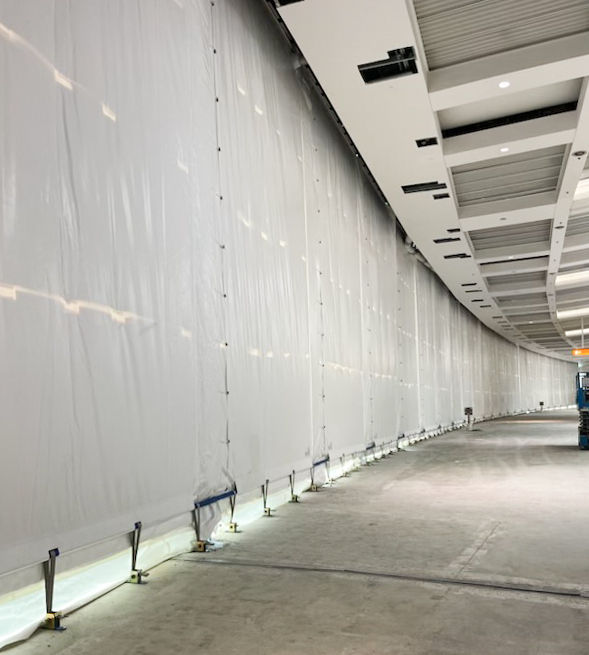
Temporary Construction Enclosures at BWI Airport
At Baltimore/Washington International (BWI) Airport, Clark Construction used RWES during the A/B Connector project to support demolition inside an active terminal. The building enclosure system created a weather-tight, temperature-controlled space that allowed demolition to move forward without delays.
Clark Construction now plans to use RWES on future projects, citing reduced risk, improved safety, and better schedule control.
“Having the RWES allowed safety stand-down meetings and morning foreman’s meetings to be conducted in conditioned space. The RWES even was utilized as a projector screen.”— Isobel Phillips, Assistant Superintendent, Clark Construction
Enclosure Systems Built for Phased Airport Construction
As construction zones shifted, temporary enclosures were reconfigured and reused across both airport projects. Panels moved easily between work areas, allowing crews to maintain containment without rebuilding as phases changed.
This adaptability helped keep site conditions consistent, reduce downtime between phases, and limit material waste over long-term expansions. From interior demolition to roof installation and terminal buildout, the building enclosure system allowed crews to adjust layouts as work progressed—protecting sensitive areas while airport operations continued uninterrupted.
The result was a controlled construction environment that balanced efficiency, safety, and public access—exactly what active airports require.
Game-Changing Benefits on Active Airport Projects
No weather downtime: Temporary construction enclosures allowed crews to work through rain, wind, and extreme temperatures without delays.
Controlled costs and schedules: Fewer weather-related interruptions helped keep projects on track and avoid budget overruns.
Improved safety on site: Built-in rails supported construction fall protection systems, reducing risk in active work areas.
Better working conditions: Crews held safety and planning meetings inside the enclosure, using protected, conditioned space for clear communication.
Focused, efficient crews: The integrated safety rail system minimized jobsite hazards so teams could stay focused on the work.
Airports demand construction solutions that work around passengers—not against them. A building enclosure system gives airport projects the control they need to stay on schedule, protect workers, and keep terminals operating at full capacity.
As major expansions like PDX and BWI continue, it’s clear why airports are relying on temporary enclosures to build smarter, safer, and without slowing the flow of travelers.


Comments